food.wikisort.org - Dish
A sfogliatella (Italian pronunciation: [sfoʎʎaˈtɛlla], plural: sfogliatelle; Neapolitan: sfugliatella), sometimes called a lobster tail in the US,[1][2] is a shell-shaped filled Italian pastry originating from Campania. Sfogliatella means "small, thin leaf/layer", as the pastry's texture resembles stacked leaves.
 Sfogliatella | |
| Type | Pastry |
|---|---|
| Place of origin | Italy |
| Region or state | Campania |
| Main ingredients | Pastry dough |
| Variations | Many types of fillings |
Origin
The sfogliatella Santa Rosa was created in the monastery of Santa Rosa in Conca dei Marini in the province of Salerno, Italy, in the 17th century. Pasquale Pintauro, a pastry chef from Naples, acquired the original recipe and began selling the pastries in his shop in 1818.[3]
Production
The dough[4] is stretched out on a large table,[5] or flattened with a pasta maker,[6] then brushed with a fat (butter, lard, shortening, margarine, or a mixture), then rolled into a log (much like a Swiss roll, but with many more layers). Disks are cut from the end, shaped to form pockets,[7] and filled. The pastry is baked[8] until the layers separate, forming the sfogliatella's characteristic ridges.
Recipes for the dough and filling vary. Fillings include orange-flavoured ricotta, almond paste and candied peel of citron.
Regional variations
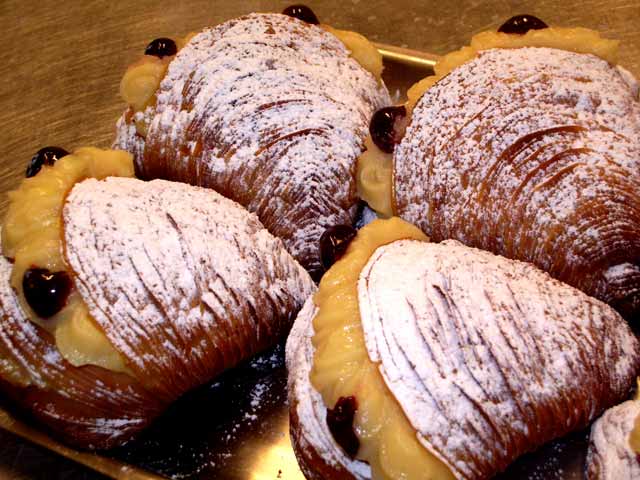
In Neapolitan cuisine, there are two kinds of the pastry: "sfogliatella riccia" ("curly"), the "normal" version, and "sfogliatella frolla," a less labour-intensive pastry that uses a shortcrust dough and does not form the sfogliatella's characteristic layers.
A variation named coda d'aragosta (in the United States "lobster tail"[9]) also exists, with the same crust but a sweeter filling: French cream, similar to whipped cream.
See also
- Baklava
- List of pastries
- Mille-feuille
- Strudel
References
- From the Source - Italy: Italy's Most Authentic Recipes From the People That Know Them Best (2015). Lonely Planet.
- Bullock-Prado, Gesine (2012). Pie It Forward: Pies, Tarts, Tortes, Galettes, and Other Pastries Reinvented. Open Road Media. p. 198.
- "storia della sfogliatella". www.sfogliatella.it.
- molinocaputo (5 March 2010). "Come Realizzare una Sfogliata Riccia". Archived from the original on 2021-12-21 – via YouTube.
- ajmichels (6 April 2009). "Sfogliatelle" – via YouTube.[dead YouTube link]
- Sylvanna (16 November 2009). "Sfogliatelle Dough". Archived from the original on 2021-12-21 – via YouTube.
- Sandie Drake (1 November 2013). "Preparing sfogliatelle pastry to make Lobster Tails". Archived from the original on 2021-12-21 – via YouTube.
- ciboespresso (27 June 2012). "CIBO ESPRESSO - Sfogliatelle". Archived from the original on 2021-12-21 – via YouTube.
- "La Sfogliatella, (Lobstertail) - Mike Mercogliano's Pastry". mikespastry.com.

| |
|---|---|
| Types |
|
| General |
|
| Poppy seed | |
| Chinese | |
| Filipino | |
| French |
|
| Greek |
|
| Indonesian |
|
| Iranian |
|
| Italian |
|
| Romanian | |
| Scandinavian |
|
| Swiss |
|
| Turkish |
|
| Related topics |
|


На других языках
- [en] Sfogliatella
[es] Sfogliatelle
Las sfogliatelle (denominadas también en singular como sfogliatella) corresponden a un dulce italiano típico y tradicional de la cocina de Nápoles, lugar de donde es originario. Se denominan así por emplear la pasta sfoglia u hojaldre ("muchas hojas").Другой контент может иметь иную лицензию. Перед использованием материалов сайта WikiSort.org внимательно изучите правила лицензирования конкретных элементов наполнения сайта.
WikiSort.org - проект по пересортировке и дополнению контента Википедии