food.wikisort.org - Dish
Buchimgae (부침개), or Korean pancake, refers broadly to any type of pan-fried ingredients soaked in egg or a batter mixed with other ingredients.[1][2][3] More specifically, it is a dish made by pan-frying a thick batter mixed with egg and other ingredients until a thin flat pancake-shaped fritter is formed.[4][5]
 Banga-buchimgae (Korean mint pancake) | |
| Alternative names | Korean pancake, buchim, jijim, jijimgae, jijimi, jeonbyeong |
|---|---|
| Type | Fritter |
| Course | Appetizer, banchan, anju |
| Place of origin | Korea |
| Associated national cuisine | Korean cuisine |
| Main ingredients | Fish, meat, poultry, seafood, vegetable, flour, eggs |

| Korean name | |
| Hangul | 부침개 |
|---|---|
| Revised Romanization | buchimgae |
| McCune–Reischauer | puch'imgae |
| IPA | [pu.tɕʰim.ɡɛ̝] |
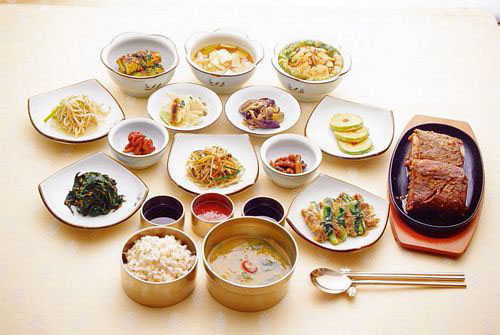 |
| This article is part of a series on |
| Korean cuisine 한국 요리 조선 료리 |
|---|
Types
Buchimgae
- hobak-buchimgae (호박부침개) – Korean zucchini pancake[6]
- kimchi-buchimgae (김치부침개) – kimchi pancake
- memil-buchimgae (메밀부침개) – buckwheat pancake
- some varieties of pajeon (파전) – scallion pancake
- some varieties of buchu-jeon (부추전) – garlic chive pancake
Jeon
Jeon is a dish made by frying a mixture of seasoned sliced or minced fish, meat, and vegetables in oil. Ingredients are coated with wheat flour prior to pan-frying the mixture in oil.[7]
Bindae-tteok
Bindae-tteok is a dish made by grinding soaked mung beans, adding vegetables and meat, and pan-frying until the mixture has attained a round and flat shape. No flour or egg is added in bindae-tteok.[8]
Jangtteok
Jangtteok is a dish made by adding wheat flour to gochujang or doenjang (soybean paste). Vegetables, such as Java waterdropworts or scallions, are added and the mixture pan-fried in oil into a thin flat pancake.
Gallery
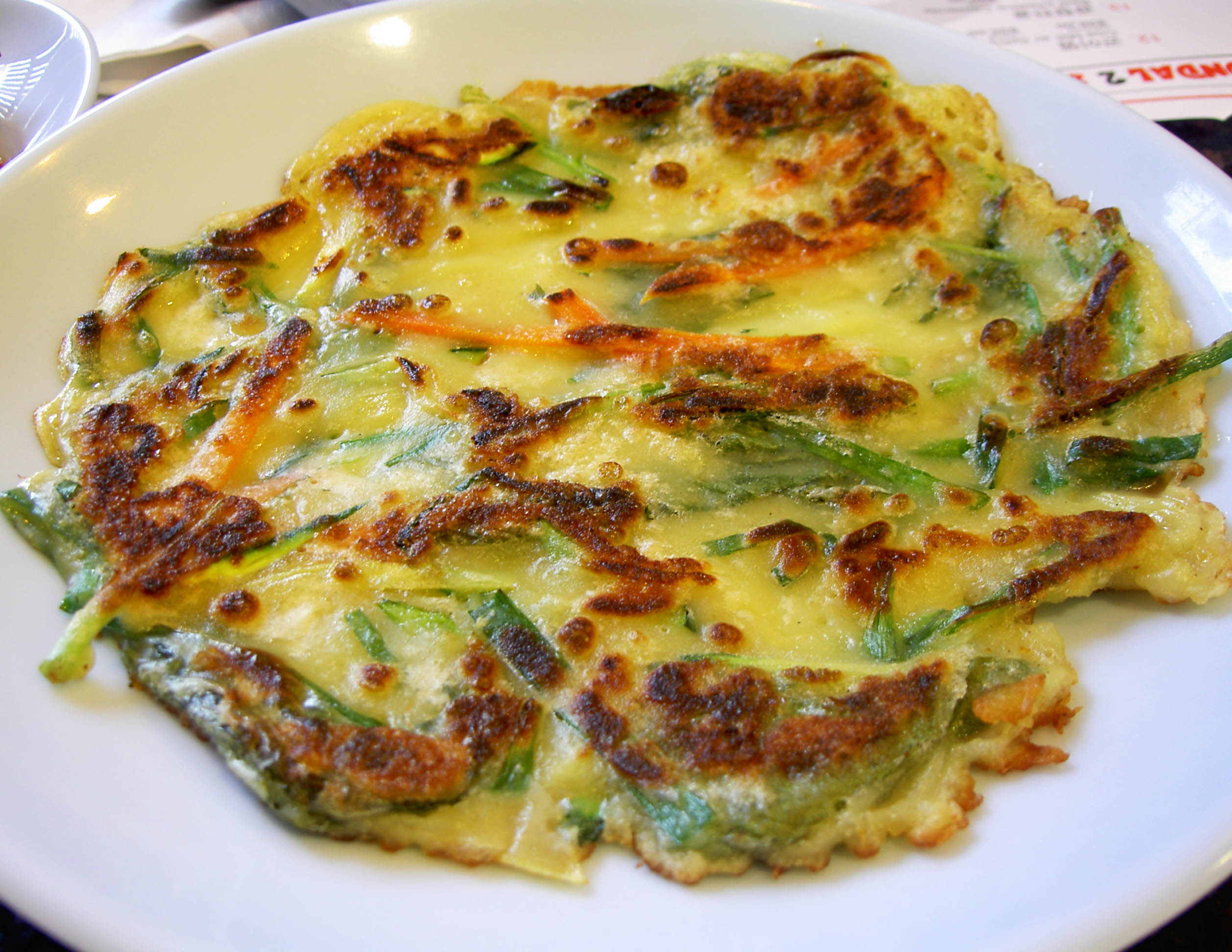
 Various buchimgae
 Aehobak-buchimgae (Korean zucchini pancake)
 Bindae-tteok (mung bean pancake)
 Buchimgae-type pajeon (scallion pancake)
 Daseulgi-buchimgae (freshwater snail pancake)
 Jeonbok-chamnamul-buchimgae (abalone and pimpinella pancake)
 Kimchi-buchimgae (kimchi pancake)
 Memil-buchimgae (buckwheat pancake)
 Stuffed mil-jeonbyeong (wheat pancake)
 Squid-buchimgae (squid pancake)




See also
References
- Allchin, Catherine M. (8 March 2016). "Korean pancakes are salty, savory, sublime". The Seattle Times. Retrieved 5 December 2016.
- "buchim" 부침. Korean–English Learners' Dictionary. National Institute of Korean Language. Retrieved 8 December 2016.
- Kim, Rahn (30 September 2014). "Guess the most searched words about Korea". The Korea Times. Retrieved 28 May 2017.
- "buchimgae" 부침개. Korean–English Learners' Dictionary. National Institute of Korean Language. Retrieved 8 December 2016.
- KOREA Magazine October 2015. Korean Culture and Information Service.
- Ro, Hyo-sun (8 August 2014). "Hobak buchim (zucchini pancakes)". The Korea Herald. Retrieved 28 May 2017.
- "jeon" 전. Korean–English Learners' Dictionary. National Institute of Korean Language. Retrieved 8 December 2016.
- "bindae-tteok" 빈대떡. Korean–English Learners' Dictionary. National Institute of Korean Language. Retrieved 8 December 2016.


Другой контент может иметь иную лицензию. Перед использованием материалов сайта WikiSort.org внимательно изучите правила лицензирования конкретных элементов наполнения сайта.
WikiSort.org - проект по пересортировке и дополнению контента Википедии